Calm you can measure — and prove.
Neural Calm is built on polyvagal theory, decades of heart-rate-variability research, and a patented natural formula. Here's exactly how it works — and how we know it's working.
Your nervous system has two gears.
One speeds you up — the sympathetic "fight or flight" response. One slows you down — the parasympathetic "rest and restore" state, governed by your vagus nerve. Chronic stress leaves most of us stuck in the first gear.
Polyvagal theory1 describes how readily you can shift between them. That flexibility — your vagal tone — is what Neural Calm is designed to rebuild.
Heart-rate variability tells the truth.
HRV is the tiny variation in time between each heartbeat. Counter-intuitively, more variability is better — it means your vagus nerve is actively regulating you, ready to shift gears.
It's the gold-standard, objective marker of nervous-system balance.2,3 We don't ask how you feel and guess — we read what your body is already telling us.
Fourteen signals. One daily Score.
The band reads 14+ physiological signals around the clock. Our model weighs them against your own baseline and distils them into a single Neural Calm Score from 0 to 100 — the one number that tells you how regulated you really are today.
Inside Anandanol
When stress tips your brain toward over-excitation, calm suffers. Anandanol's patented Passiflora blend acts like a dimmer — rebalancing your inhibitory GABA pathways against your excitatory glutamate pathways.
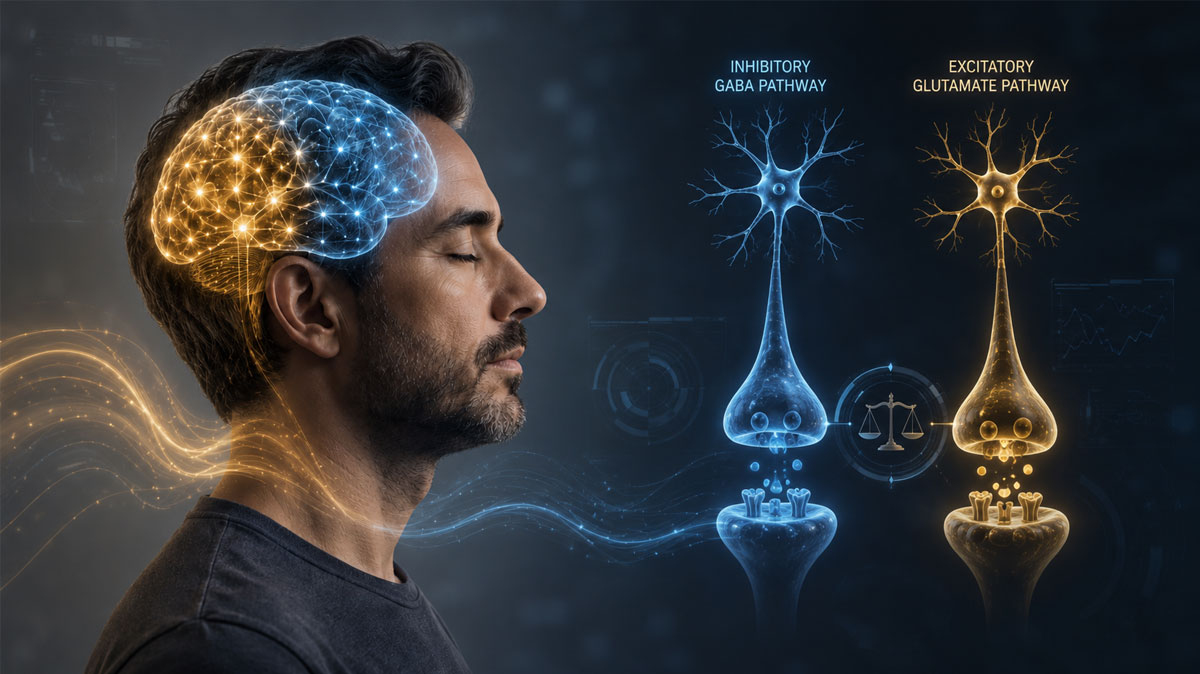
Passiflora Blend4
Rebalances GABA and glutamate pathways through a natural endocannabinoid effect.
Magnesium Glycinate5
Supports a sense of calm and helps maintain steady nerve-cell signalling.
CoQ10
Fuels cellular energy, supports immunity, and adds antioxidant protection.
Vitamin B6 (P5P)6
Active P5P form absorbs immediately — full benefit from the first dose.
What members actually experience.
Figures reflect reported and self-reported outcomes from Neural Calm members; individual results vary. Anandanol™ is a natural formula (US Patent #8828453) and is not intended to diagnose, treat, cure or prevent any disease.
The science, answered.
What exactly is vagal tone?
It's how strongly and quickly your vagus nerve can switch you from a stressed state into a calm one. Higher vagal tone means faster recovery from stress — and it can be trained over time.
Why measure HRV instead of just asking how I feel?
Feelings are subjective and easy to misread. HRV is an objective, physiological signal that reflects what your nervous system is doing right now — so progress is measured, not guessed.
Is Anandanol™ a drug?
No. It's a patented natural herbal, mineral and vitamin composition (US Patent #8828453), developed by an endocrinologist and a pharmacist to support calm and focus without the side effects often associated with pharmaceuticals.
How quickly will I see changes in my Score?
Most members build a baseline in the first week and notice their Calm Score trending upward within two to four weeks of daily use. Your coach helps you read and act on those trends.
The research behind it.
Peer-reviewed studies on the mechanisms and individual ingredients that Neural Calm is built on.
Porges, S.W. (2007). The polyvagal perspective. Biological Psychology, 74(2), 116–143.
Shaffer, F. & Ginsberg, J.P. (2017). An overview of heart rate variability metrics and norms. Frontiers in Public Health, 5, 258.
Thayer, J.F., et al. (2012). A meta-analysis of heart rate variability and neuroimaging studies. Neuroscience & Biobehavioral Reviews, 36(2), 747–756.
Akhondzadeh, S., et al. (2001). A double-blind randomised trial of Passiflora (passionflower) extract. J. Clinical Pharmacy & Therapeutics, 26(5), 363–367.
Boyle, N.B., Lawton, C. & Dye, L. (2017). The effects of magnesium supplementation on subjective measures of stress — a systematic review. Nutrients, 9(5), 429.
Field, D.T., et al. (2022). High-dose vitamin B6 supplementation and self-reported measures of mood. Human Psychopharmacology, 37(6), e2852.
Anandanol™ mind-body regulation composition. US Patent #8,828,453 (2014).
These references concern the underlying science and individual ingredients of the formula, not the Neural Calm system as a whole. They are provided for transparency and are not a claim that Neural Calm diagnoses, treats, cures or prevents any disease.
See the science work on you.
Build your baseline this week and watch your own Neural Calm Score rise.